Disclosures in Accordance with TCFD Recommendations
Introduction
The Valuence Group recognizes climate change as one of the most important management issues in our business activities. We will strengthen our governance structure to resolve climate change issues, analyze the impact of climate change risks on our business, implement appropriate responses, and capture growth opportunities, aiming to reflect these efforts in our corporate strategy. To this end, Valuence endorses the recommendations made by the Task Force on Climate-related Financial Disclosures (TCFD) established by the Financial Stability Board. We take active measures to address climate change and disclose related information, aiming to create a sustainable society and environment and achieve sustainable growth for the Group.
Governance
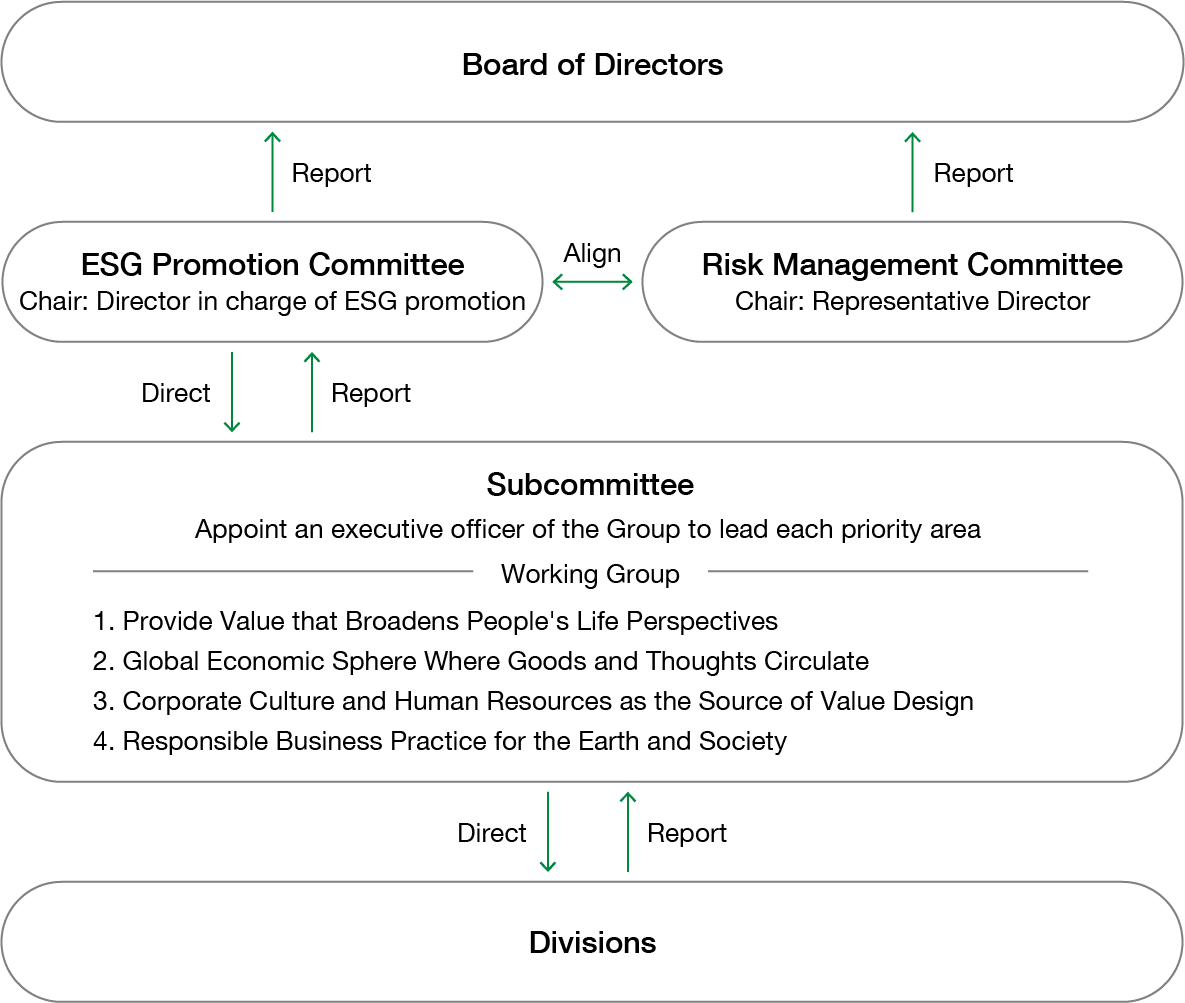
Valuence views sustainability as a key management priority. Based on this recognition, the Board of Directors reviews and approves significant sustainability matters. Appointing outside directors with expertise in sustainability allows the Board to maintain the appropriate knowledge, experience, and skills necessary to oversee sustainability.
The ESG Committee, established as a supporting body of the Board, is responsible for practical matters related to the execution of overall sustainability operations. The committee identifies sustainability risks and opportunities, identifies materialities, sets indicators and targets to resolve issues, and manages progress. We also establish subcommittees for each priority area under the ESG Committee and appoint a committee member to lead each subcommittee. The purpose of this structure is to clarify accountability for sustainability strategy and strengthen the integration of sustainability management across the organization.
The Board of Directors receives reports on matters discussed and resolved by the ESG Committee and the Risk Management Committee. The Board reviews these reports, deliberates on Group policies and action plans to address sustainability issues, and oversees execution. The director in charge of ESG serves as chair of the ESG Committee and holds executive responsibility for sustainability initiatives. Additionally, the representative director serves as chair of the Risk Management Committee and holds ultimate executive responsibility for risk management, including sustainability-related risks.Climate Governance
Strategy
Risks and Opportunities Over the Short-, Medium-, and Long-Term
Climate-related risks and opportunities may affect the Group over the long term. To this end, we recognize the need to set milestones and asses such risks and opportunities accordingly. We structures our assessment across short-, medium-, and long-term periods and evaluated climate-related risks and opportunities for each interval. The definitions of each period are as follows.
| Period | Scope | |
|---|---|---|
| Short Term | Through FY8/2027 | Period through the target year of the medium-term management plan |
| Medium Term | Through FY8/2030 | Period through the SBT near-term target year and the Group long-term environmental target year |
| Long Term | Through FY8/2050 | Period through the SBT net-zero target year |
Process for Determining the Impact of Risks and Opportunities on Business, Strategic, and Financial Plans
We conducted scenario analyses for our core businesses of buying and selling luxury brand goods, antiques, and art. These analyses aimed to assess climate-related risks and opportunities and impact on the Group, evaluate the resilience of our strategy, and consider the need for additional measures. In conducting our analyses, we selected the 1.5℃ scenario and the 4℃ scenario.
| Selected Scenarios | 1.5℃ Scenario | 4℃ Scenario |
|---|---|---|
| Impact on society and the business environment | A world in which bold policies are implemented and technological innovation is pursued to achieve net-zero emissions worldwide by 2050. Transition risks and opportunities, including social changes associated with the transition to a decarbonized society, are more likely to emerge. | A world in which climate change measures remain insufficient and current emission levels continue, leading to continued fossil fuel–dependent economic growth. International cooperation and policy responses remain limited, extreme weather events and natural disasters increase, and physical risks are more likely to emerge. |
| Reference | 「Net‐Zero Emissions by 2050 Scenario(NZE)」(IEA) | 「Representative Concentration Pathways(RCP8.5)」(IPCC) |
Scenario Analysis Results and Strategic Resilience
The Valuence Group recognizes the need for ongoing efforts to strengthen strategic resilience to achieve carbon neutrality. To this end, we examined specific measures based on our belief that it is important to ensure appropriate risk transfer, avoid, or mitigate risks, while also taking a proactive approach to respond to opportunities.
We incorporate items of particular significance into the Group strategy and manage those items.
The following table outlines the major risks and opportunities we identified, our responses, and the resilience of our strategy.
Summary of Valuence Group Climate-Related Risks and Opportunities
| Category | Major Risks and Opportunities | Timeframe | Degree of Impact | Major Responses | ||
|---|---|---|---|---|---|---|
| Risks | Transition Risk | Policy and Legislation |
Higher electricity and energy costs Higher electricity rates resulting from the introduction of carbon taxes and emissions trading schemes may increase operating costs (electricity and HVAC) at stores and logistics bases. |
Short to long term | Medium |
|
|
Higher logistics and transportation costs The introduction of carbon taxes and fuel levies may lead to higher fuel costs and an increase domestic and international logistics and transportation costs associated with the movement and sale of purchased goods. |
|
|||||
| Market |
Increase in raw material costs Higher electricity and fuel prices may increase logistics and operating costs. |
Short to long term | Medium |
|
||
| Reputation |
Decline in corporate value due to delayed climate action If stakeholders perceive climate-related action as insufficient in the reuse business, financing costs may increase due to less favorable lending terms from investors and financial institutions. Reduced engagement from environmentally conscious consumers and the loss of partnership opportunities may also result in lower net sales. |
Short to long term | High |
|
||
| Physical Risks | Acute |
Suspension of or damage to store and logistics operations due to natural disasters Larger typhoons and increased heavy rainfall may flood or damage stores and logistics facilities, resulting in lost sales opportunities, repair costs, and inventory losses from business suspensions or shutdowns. |
Short to medium term | Medium |
|
|
| Chronic |
Decline in customer traffic due to extreme weather Extreme weather events, including heat waves and heavy rainfall, or the spread of infectious diseases may reduce outings, leading to lower in-office purchasing volumes and lower retail net sales. |
Medium to long term | Medium |
|
||
| Opportunities | Resource Efficiencies |
Resource efficiency through energy conservation and logistics optimization Resource efficiency may reduce operating costs. |
Short to medium term | Medium |
|
|
| Products and Services |
Strengthened competitiveness driven by rising environmental awareness Growing consumer environmental awareness may expand circular consumption, leading to new customer development, the creation of circular services, and expanded market share. |
Short to medium term | High |
|
||
| Services and markets related to our products |
Expansion of the circular consumption market due to rising environmental awareness Demand for low-environmental-impact reuse and repair services may increase. |
Short to medium term | High |
|
||
The results of the above scenario analyses prompted the Valuence Group to reaffirm our significant transition risks. These risks include increased financing costs as a result of lower evaluations by investors and financial institutions if our climate action is deemed insufficient and lower net sales resulting from reduced engagement by environmentally conscious consumers and lost partnership opportunities.
We also recognized the potential impact of natural disasters on stores and logistics facilities as a significant physical risk. At the same time, the Valuence Group reaffirmed opportunities to expand the market for reuse, a core business of the Group. These opportunities would arise from the growing adoption of the circular economy in line with rising consumer environmental awareness. In light of these findings, we take proactive measures to achieve carbon neutrality based on our view that addressing the identified risks will also support the pursuit of business opportunities and enhance corporate value.
We review and implement various relevant measures in recognition that addressing high-impact risks is a particularly urgent priority. Specifically, we strive to participate in and endorse various initiatives, expand climate-related disclosures, and strengthen disaster preparedness systems. We strive not only to reduce Scope 1 and Scope 2 emissions but also to prioritize action in Scope 3 by focusing on categories with higher emissions as we work toward carbon neutrality.
Risk Management
The Valuence Group selects activities related to climate-related risks and opportunities, focusing on core businesses, and conducts detailed examinations through the ESG Committee.
The ESG Committee reports matters discussed and reviewed to the Board of Directors. Risks and opportunities found to be particularly important are reflected in Group strategies and managed by the ESG Committee.
We also share the results of climate change risk analysis and the status of initiatives with the Risk Management Committee, which oversees risk management across the Group. The Risk Management Committee monitors the management of climate-related risks and works with the ESG Committee to manage theses risks.
Metrics and Targets
The Valuence Group positions climate change as a material management issue and establishes GHG emissions as a key indicator. We established a target to achieve carbon neutrality across Scope 1, 2, and 3 by the fiscal year ending August 2030 and aim to obtain Science Based Targets (SBT) certification during the fiscal year ending August 2026. The following table presents our indicators, targets, and progress.
| Metrics | FY8/2024 Actual |
FY8/2025 Actual |
FY8/2027 Target |
FY8/2030 Target |
|---|---|---|---|---|
|
GHG emissions reduction rate (Scope 1 and 2) (Base year: FY8/2023) |
13.4% increase | 22.2% increase | 50% | 90% |
| GHG emissions (Scope 1, 2, 3) | 96,416 t-CO₂e | 89,420 t-CO₂e | - | Carbon Neutral※ |
| Renewable energy ratio (electricity) | 1.3% | 12.8% | 50% | 100% |
※ We plan to offset any remaining emissions in accordance with SBT-compliant methodologies on the premise that we have pursued emissions reduction efforts.
Scope 1 and 2 emissions for the fiscal year ended August 2025 increased 22.2% compared with the fiscal year ended August 2023. This result was due to an increase in fluorocarbon leakage stemming from the removal of HVAC equipment in the relocation of logistics bases. We also saw an increase in electricity consumption following the construction of ALLU SHINJUKU and a new automobile maintenance facility. However, the renewable electricity ratio across the Group increased to 12.8% as we began reviewing electricity purchase agreements at our sites in Japan under direct electricity contracts and switched to renewable electricity.
Total emissions, including Scope 1, 2, and 3, decreased 7.3% year on year. This decrease was mainly due to fluctuations in procurement volumes of certain precious metal products and changes in the vehicle sales mix associated with a stronger focus on TWISTED. Our current GHG emissions data has not undergone third-party assurance; however, we will explore the introduction of external assurance to enhance data reliability.
Looking ahead, we will explore and implement specific measures to reduce GHG emissions and expand related disclosures to provide transparent reporting to stakeholders.
GHG emissions results for previous fiscal years are available under ESG Data.
Updated Jan. 9, 2026