Valuence Holdings Inc. (Tokyo; Shinsuke Sakimoto, representative director and president; the “Company”) announced changes to the calculation method of Resale Impact, an index that measures environmental impact reduction achieved through brand resale.
Background to Avoided Emissions Calculation and Company Initiatives
Avoided emissions are an index that quantifies the environmental value generated through products and services that help reduce greenhouse gas emissions. Discussions on calculation and disclosure have progressed in Japan and overseas in recent years. However, detailed and standardized calculation rules have not yet been established in many industries, and no unified methodology exists in the resale sector.
Valuence luxury products, including watches, jewelry, and bags, offer durability supported by high technical capabilities and quality and enable long-term use. Resale of these products helps reduce environmental impact. However, the environmental value generated through resale has not yet been sufficiently quantified.
Based on this recognition, Valuence began calculating and disclosing Resale Impact in 2021 as a metric to quantify the reduction in environmental impact achieved through the Company reuse business.
Valuence has now updated the calculation method in response to evolving avoided emissions guidelines in Japan and overseas.
Resale Impact
Valuence enables product circulation through brand resale, allowing products to remain in use for their full useful life rather than becoming short-lived. The Company defines Resale Impact as a metric to quantify and disclose the environmental value created by brand resale across society based on an avoided emissions methodology.
Calculation Method
Valuence’s methodology evaluates the reduction in environmental impact achieved through the recirculation of products and the extension of product life through brand resale, which reduces the need for new resource extraction and manufacturing. The calculation uses company transaction data and incorporates actual data where available, including measured product weight and transportation records. The assumed usage period for key categories (watches, jewelry, and bags) is based on a customer survey conducted by Nanboya, a Valuence Group brand (3,947 valid responses).
The methodology is based on the resale service avoided emissions calculation framework developed by ZEROC Inc., an LCA consulting firm. The methodology has also undergone an expert, third-party peer review by Professor Ichiro Daigo of the Research Center for Advanced Science and Technology, The University of Tokyo.
The scope of calculation is as follows:
・Eligible services: Brand resale services
・Eligible product categories: Watches, jewelry, bags, cases, accessories, apparel, shoes
For more information, visit the sustainability page on the corporate website:
https://www.valuence.inc/sustainability/resale-impact/
FY2025 Resale Impact
The following results reflect items resold through ALLU, STAR BUYERS AUCTION, and ALLU AUCTION.
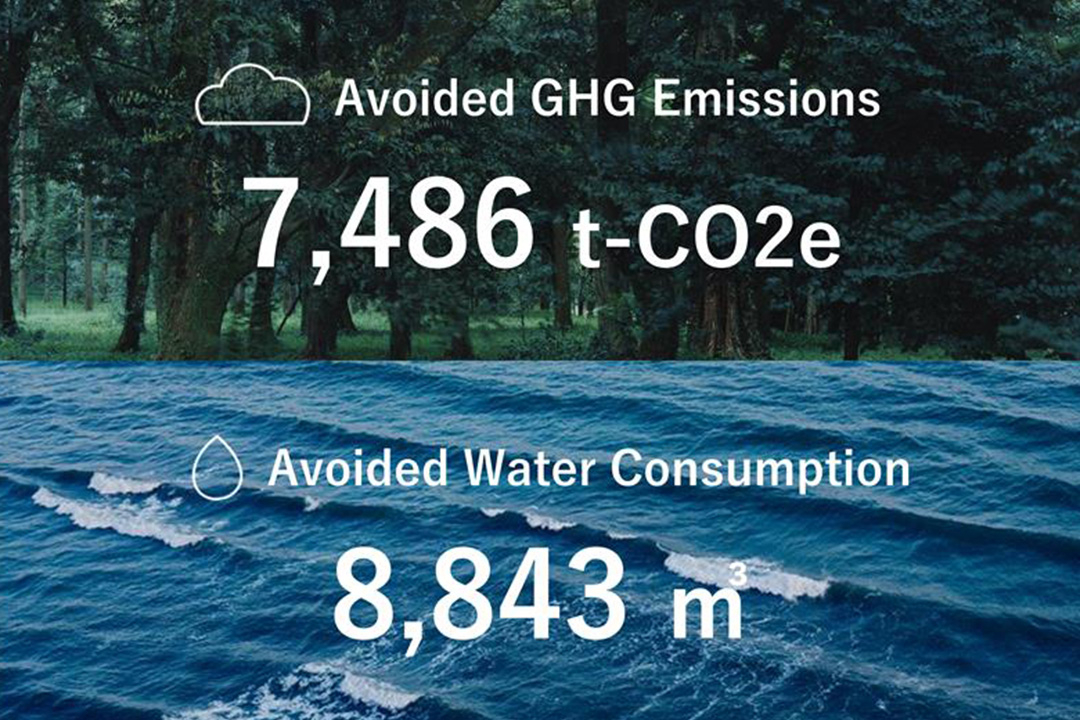
・Avoided GHG emissions:7,486 t-CO2e
・Avoided water Consumption:8,843 m³
A GHG emissions reduction of 7,486 t-CO2e is equivalent to the amount of CO2 absorbed annually by approximately 850,000 cedar trees.
* Calculated on the assumption that one cedar tree absorbs an average of approximately 8.8 kg of carbon dioxide per year.
Rollout to ALLU
Valuence will replace Resale Impact figures displayed on merchandise tags across ALLU stores, the Group’s pre-owned brand shops, to values calculated under this methodology on a phased basis. This transition will apply to both the domestic e-commerce site and physical stores.
The Valuence Group will continue to visualize and disclose the environmental value of reuse to help accelerate the transition to a circular economy and build a sustainable society.